NAS Guides · Published 2026-10-26
An AI Photo Album for iPhone 17 Shots, No Cloud Required
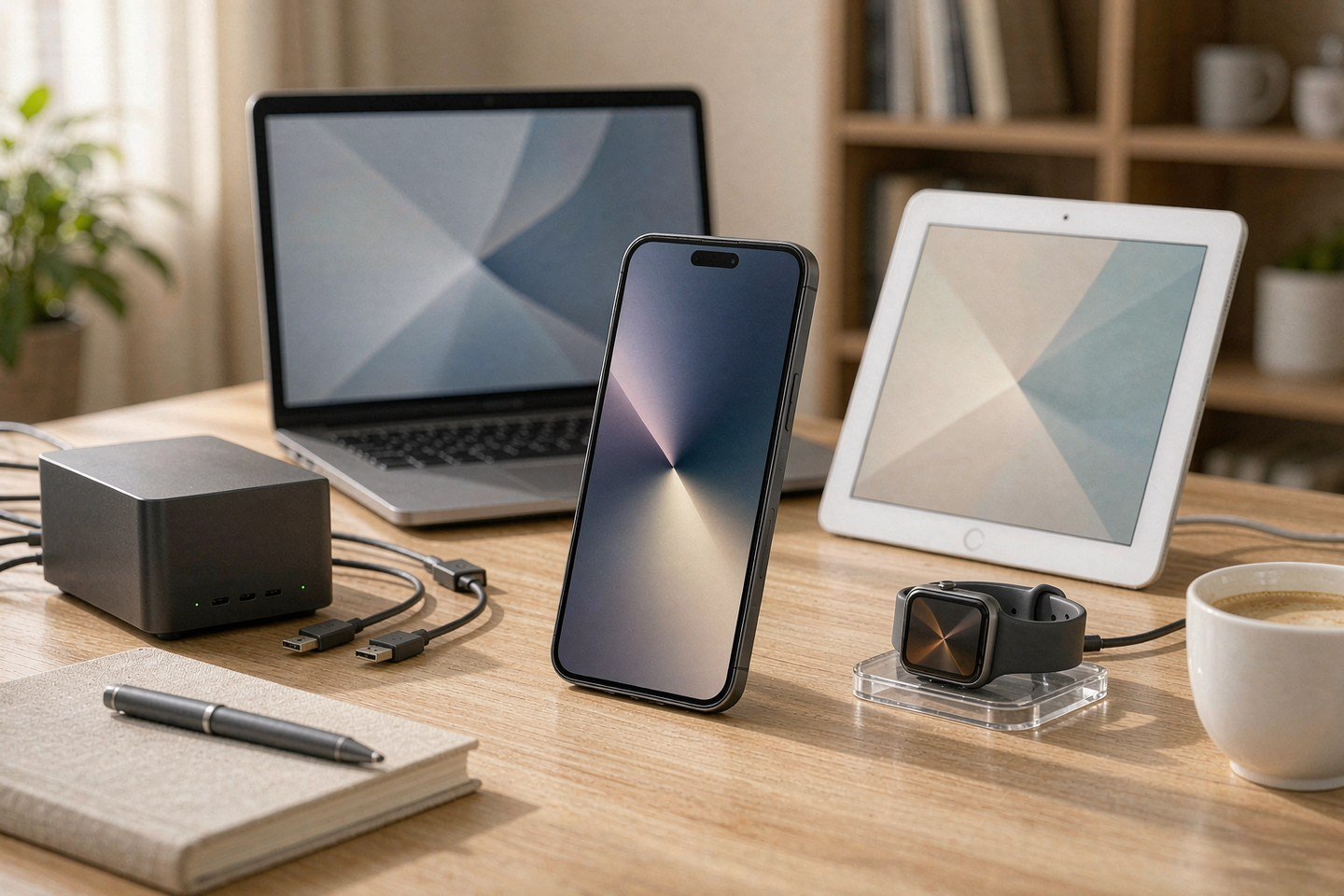
Direct answer up front, then the trade-offs that matter. This page covers iphone 17 ai photo album and answers: What is a NAS and do I need one?.
By Leo · Hardware Reviewer
Beat: Drive bays, RAID and expandability · How we review
Quick Answer
Yes — Immich runs face recognition and CLIP contextual search on your own NAS, and Synology Photos handles shared albums, so no Apple cloud is required for the album itself. The iPhone 17 (A3258) shoots 48 MP stills into a 256 GB base, which is what makes your storage question urgent. Worth a weekend of setup if you shoot a lot; skip it if you take twenty photos a month.
Key Takeaways
- Carrier deals are pulling the iPhone 17 toward free: Mashable reported on 2026-10-24 that T-Mobile gives the iPhone 17e free with a switch and the iPhone 17 for under $100 with a ported number on Experience More or Experience Beyond (accessed 2026-10-26).
- The iPhone 17's main camera is 48 MP and base storage is 256 GB (Apple technical specifications, checked 2026-10-11).
- Immich's documentation lists local CLIP contextual search plus filters for People, OCR text, Locations, Tags and camera model (accessed 2026-10-26).
- iCloud+ costs $9.99 per month for 2 TB (Apple Support, checked 2026-10-02); a Synology DS225+ listed at $364.99 on Amazon (checked 2026-10-02) is a one-time hardware buy.
- The trade-off: you swap subscription money for setup work, indexing time, and a second app in your pocket.
What Changed
CNET's current deals roundup frames the iPhone decision as a price gap: the iPhone 18 Pro starts at $1,199, while carrier and trade-in offers keep pulling the iPhone 17 toward free (accessed 2026-10-26). Apple's trade-in program pays up to $885 toward an iPhone 17, T-Mobile's eligible-trade-in offer nets one at no cost, and a new Verizon line knocks $840 off — all per CNET's roundup.
Mashable's 2026-10-24 post adds the fine print: the savings arrive as bill credits over 36 months, leaving early means paying the remaining balance, and checkout still includes sales tax on the full retail value plus a $35 per-line connection fee (accessed 2026-10-26). A "free" phone is really a 36-month commitment with a small upfront tax bill.
Read that twice.
The realistic outcome is a wave of near-free iPhone 17 handsets. Each one records 48 MP frames (Apple specifications, checked 2026-10-11), and you eventually ask the same question every new owner asks: where do those photos get organized and searched — Apple's cloud, or hardware in your closet?
Who Is It For
See whether you are one of these three. You are a family archivist if you share one library with a partner and want face grouping that never leaves your house. You are a creator if you shoot thousands of frames per month and already run a NAS for footage. And you are the privacy-motivated buyer if you like Apple's hardware but want the search index on your own disk.
You should skip it if you take a few dozen photos a month. iCloud+ costs $2.99 per month for 200 GB (Apple Support, checked 2026-10-02), the Photos app does the grouping for you, and nothing in that routine needs a Docker container. Your setup tax would dwarf your $36 annual bill.
Key Specifications
Capacity and bays
Apple lists the iPhone 17 (A3258) at 256 GB base and 512 GB maximum storage, with a 48 MP main camera, the A19 chip, and a weight of 0.18 kg (Apple technical specifications, checked 2026-10-11). Storage, not the camera, is the constraint — 48 MP files eat a 256 GB phone fast.
Across the cable sits the Synology DS225+: two SATA drive bays, 2 GB of RAM installed and 6 GB maximum, a 4-core Intel Celeron J4125, one 1GbE and one 2.5GbE port, and a 3-year warranty (Synology's official comparison page, checked 2026-10-02). It is a deliberately modest machine, which matters below.
Connectivity
The iPhone 17's USB-C port runs at USB 2 speeds — 480 Mb/s (Apple technical specifications, checked 2026-10-11). Wired offload of a full library is a slow afternoon, so plan on Wi-Fi sync through the album app's mobile client instead. On the NAS side, the DS225+'s 2.5GbE port matters once two people browse the library at the same time.
Software stack
Immich stores metadata in Postgres and runs CLIP contextual search through the VectorChord extension, per its official documentation; free-text queries work without keyword tags, and filters cover People (recognized faces), OCR text inside images, Locations from reverse geocoding, Tags, camera make and model, and time frames (accessed 2026-10-26). That camera filter is the quiet win: every iPhone 17 shot identifies itself as such.
Synology Photos, DSM's built-in album app, covers the sharing half — a single photo or an entire album goes out through a unique link with access controls (Synology's product page, accessed 2026-10-26).
What Is New
The phone is not the new part of this story; the local software is. Immich's search documentation now treats OCR, reverse-geocoded locations and model-level camera filters as first-class content types alongside face grouping (accessed 2026-10-26). Synology Photos keeps album sharing inside DSM without an extra subscription line item.
Discounts move the album question.
Apple's side did not stand still. CNET's coverage ties the current lineup to the iPhone 18 Pro's $1,199 starting price and the newest chips, which is exactly why the cheaper-but-current iPhone 17 keeps showing up in deal posts (accessed 2026-10-26). The album question follows the discount, not the launch event.
How It Compares
The two devices do different jobs, so treat the table as your division of labor: the phone captures, the NAS classifies and keeps.
| Field | Apple iPhone 17 | Synology DS225+ (2025) |
|---|---|---|
| Price (tracked) | Apple US store $899 (2026-10-11);Apple US store $929 (2026-10-11) | Amazon $364.99 (2026-10-02) |
| Drive bays (SATA) | — | 2 bays |
| M.2 NVMe slots | — | 0 slots |
| Max bays with expansion | — | 7 bays |
| CPU | Apple A19 | Intel Celeron J4125 |
| Installed RAM | — | 2 GB |
| Max RAM | — | 6 GB |
| 1GbE ports | — | 1 port |
| 2.5GbE ports | — | 1 port |
| Weight | 0.18 kg | 1.3 kg |
| Warranty | — | 3 years |
| Base storage | 256 GB | — |
| Max storage | 512 GB | — |
| Main camera | 48 MP | — |
| USB-C data speed | USB 2 (480 Mb/s) | — |
_— = no verified data in our spec ledger; we do not substitute numbers from other products._
Two devices, one job each.
Five years of iCloud+ at the 2 TB tier runs $599.40 ($9.99 per month for 60 months, Apple Support price checked 2026-10-02). The DS225+ body is $364.99 at Amazon (checked 2026-10-02) before drives. Your arithmetic favors hardware if you stay past roughly three years; the cloud wins on never thinking about disks.
Who Should Consider It
Worth it if you add thousands of photos a year, own or plan a 2-bay NAS, and want the face index on hardware you can unplug. Our take: the OCR and camera-model filters are the features that change your daily use, because searching a screenshot for text beats scrolling a camera roll.
The filters earn their keep.
Skip it if your whole library fits in 200 GB and you already pay Apple $2.99 a month for that tier. Skip it too if nobody under your roof enjoys maintaining a server — Immich needs updates, and an abandoned photo server is worse than iCloud in every way that counts.
What Existing Users Should Know
If you already back up your iPhone 17 to a NAS — our earlier walkthrough covers that automation — the album layer sits on top of the same library, not instead of it. Two cautions before you merge anything. Keep your backup job and your album importer pointed at separate copies until you have confirmed the import; combining them on day one is the classic path to a half-indexed collection. And an index is not a backup: if your NAS dies, the face clusters and tags go with it, so keep a versioned copy that the backup-versus-ransomware math already argues for.
The first index pass over a multi-year library is the slow part. Immich's machine-learning settings live under Administration > Settings > Machine Learning Settings (documentation accessed 2026-10-26), and the project documents hardware-accelerated machine learning as a feature. We could not verify real-world indexing throughput on a J4125-class CPU, so budget a weekend rather than an evening for a large library.
Real-World Scenario: AI Smart Photo Album & Face/Scene Classification
What this changes for the use case
Picture the actual moment: your phone holds four years of family photos and you type "passport" into a search box. On a local Immich install that query hits the OCR index and returns the documents in your camera roll, because the documentation lists Optical Character Recognition as a searchable content type (accessed 2026-10-26). Face grouping works the same way — the People index recognizes faces in photos and videos on your disk, with no upload to Apple in the loop.
Your camera roll becomes a queryable database.
For your household, Synology Photos adds the sharing half: one photo or a whole album goes out through a unique link with access controls (Synology's product page, accessed 2026-10-26). The scenario, stated plainly, is your family album searching like a private search engine that never phones home.
Hardware and software requirements
The floor is low. Any NAS that runs Docker can host Immich, which needs a Postgres database plus its machine-learning container. The DS225+ in the table above has 2 GB of RAM installed, accepts 6 GB, and provides one 1GbE and one 2.5GbE port (Synology's official comparison page, checked 2026-10-02). Immich documents hardware-accelerated machine learning as a supported feature, with tuning under Administration > Settings > Machine Learning Settings (accessed 2026-10-26). On your phone side there is nothing to configure beyond the mobile app and one initial sync over Wi-Fi.
That's the whole checklist.
Limits, caveats, and who should skip it
Watch out for three limits. Indexing speed on a low-power Celeron J4125 is not something we could verify — vendor documentation describes the pipeline but publishes no throughput figure for this CPU, so treat any performance promise as unconfirmed. The album app is not Apple Photos: there is no deep iOS integration and no on-device suggestions while you shoot. And the wired path is capped by the iPhone 17's USB 2 port at 480 Mb/s (Apple specifications, checked 2026-10-11), so the first bulk transfer goes over Wi-Fi and takes hours.
Skip this setup if you want photography to be zero-thought. It is a server, it needs updates, and the reward — a searchable, face-grouped archive that stays in your house — only pays off if you actually search your library.
Frequently Asked Questions
What is a NAS and do I need one?
A NAS (network-attached storage) is a small server that holds drives and serves files to every device on your network. You need one here because your AI album — face clusters, CLIP search, tags — lives in a database on that box, not on your phone. Without one, you rent the equivalent from Apple, where iCloud+ 2 TB runs $9.99 per month (Apple Support, checked 2026-10-02).
How much does a home NAS cost?
The 2-bay Synology DS225+ listed at $364.99 on Amazon (checked 2026-10-02) before drives, and our price ledger tracks a WD Red Plus 8 TB at $431 (checked 2026-10-02). One drive is enough to start. Set that total against the five-year iCloud+ 2 TB figure of $599.40 and the hardware pays for itself if you keep it longer than about three years.
Can a NAS replace cloud storage?
Partly. Local storage handles classification, search and in-home sharing well. What it does not cover automatically is off-site access and off-site protection: reaching your album from outside takes a VPN, a relay or careful port forwarding, and theft or fire can take both copies at once. The remote-access trade-offs deserve their own read. A hybrid — local album plus some off-site copy — is the honest answer.
Do I still need iCloud if I run a local AI album?
Most people keep a slice of it — you probably will too. iCloud+ at $2.99 per month for 200 GB (Apple Support, checked 2026-10-02) is a cheap off-site layer while your NAS holds the searchable master copy. What you can drop is the big tier: the point of the local album is that the 2 TB plan at $9.99 per month stops being the place your library actually lives.
Sources
- Mashable staff post, 2026-10-24 — details of T-Mobile's current iPhone 17 and 17e promotion, including the 36-month credit schedule, early-exit balance, and checkout fees (accessed 2026-10-26) — https://mashable.com/tech/oct-24-free-apple-iphone-deal
- CNET deals roundup — current iPhone 17 trade-in and carrier credit offers, alongside the iPhone 18 Pro's starting price (accessed 2026-10-26) — https://www.cnet.com/deals/best-iphone-17-deals/
- Immich official documentation, "Searching" — local CLIP contextual search on Postgres and VectorChord, with People, OCR, Locations, Tags and camera filters (accessed 2026-10-26) — https://immich.app/docs/features/searching
- Synology Photos product page — unique-link album sharing with access controls in DSM (accessed 2026-10-26) — https://www.synology.com/en-global/dsm/feature/photos
- Apple — iPhone 17 Technical Specifications — 48 MP main camera, 256/512 GB storage, A19 chip, USB 2 port (checked 2026-10-11) — https://www.apple.com/iphone-17/specs/
- MacPrices.net — US iPhone price tracking used for the $899 carrier-connection and $929 unlocked readings (checked 2026-10-11) — https://www.macprices.net/apple-iphone
- Apple Support — iCloud+ plan pricing (checked 2026-10-02) — https://support.apple.com/en-us/108047
Run your own 5-year cost comparison with the on-site calculator
Every figure above is attributed in the Sources list — put your own drive count and subscription tiers into the calculator to see where you land.
Open the cost calculator →Related reading
Was this article helpful?
One tap, no account and no comment box. It tells us which guides are actually worth updating.
How many drive bays is your NAS?
This is how we decide which setups to cover next.
Thanks.
Need help with a specific setup?
Storage choices depend on your drives, your budget and how many people share the box. Tell us what you are building and we will point you at a configuration that fits — no obligation, no sales script.
Affiliate Disclosure: SecureNAS Hub may earn a commission from qualifying purchases made through links on this page, at no extra cost to you. Facts and figures are attributed in the Sources list; nothing on this page is a fabricated test result. See our full disclosure. Product images are either supplied by the manufacturer or clearly labelled as illustrative renders; each one is captioned accordingly. Last reviewed 2026-10-26.