NAS Guides · Published 2026-09-28
Hard drive prices make no sense right now, and buying the wrong NAS drive can cost you twice as much
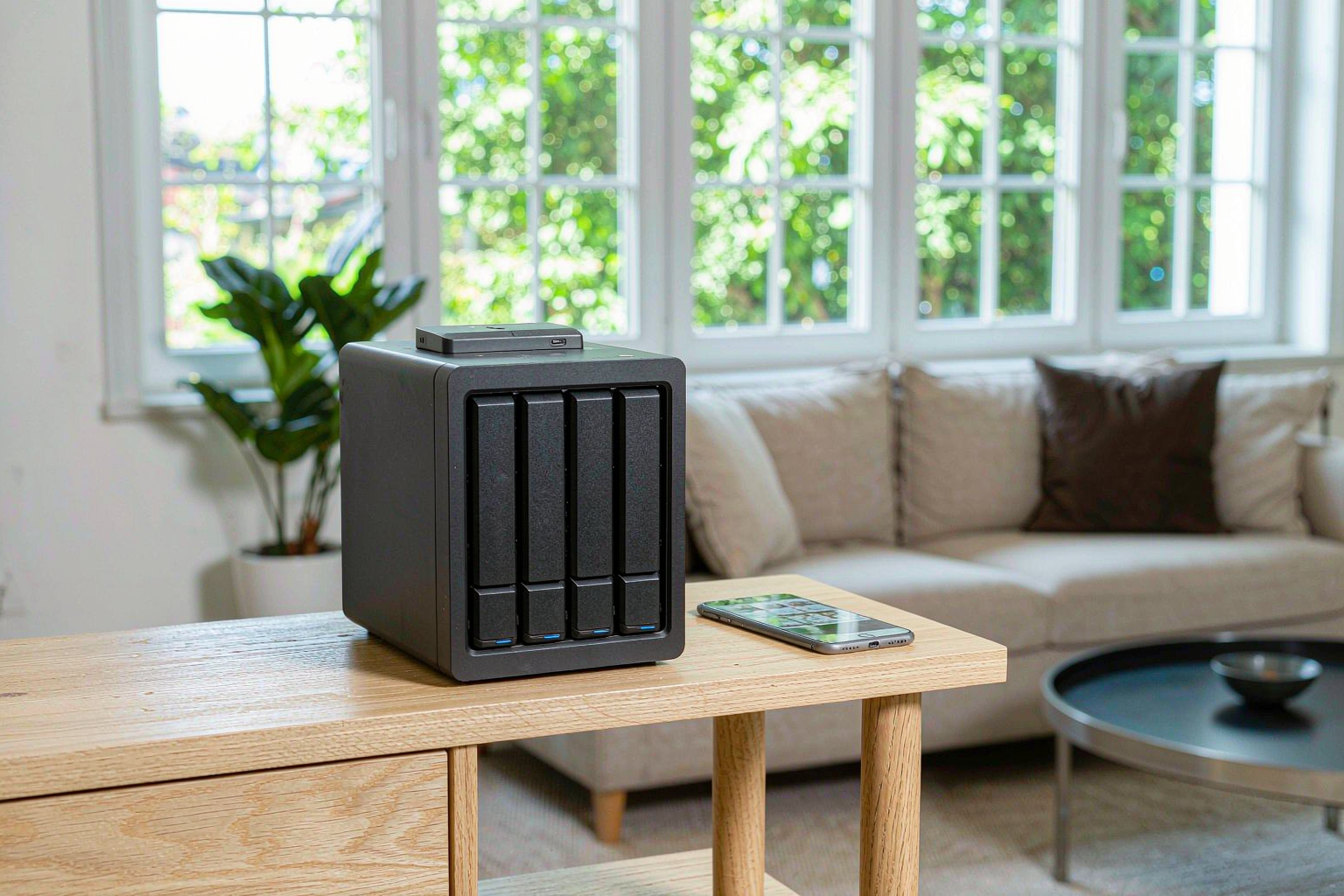
Direct answer up front, then the trade-offs that matter. This page covers hard drive prices and answers: What is a NAS and do I need one?.
By Anne · Storage and Home Tech Editor
Beat: Phone photo backup · How we review
Quick Answer
Hard drive prices have risen by an average of about 46% since September 2025, according to price research from the German outlet ComputerBase reported by Tom's Hardware (accessed 2026-09-28). The cause is a supply squeeze, not a shortage of factories: AI data centers have pre-booked nearly all high-capacity output from Western Digital and Seagate. Western Digital says it is "pretty much sold out for calendar year 2026," and Seagate says its nearline capacity is fully allocated through 2026 (heise online, accessed 2026-09-28). For NAS buyers the practical rule is blunt: shop by cost per terabyte and by CMR recording, not by the "NAS" or "enterprise" badge on the box.
Key Takeaways
- Hard drive prices are up roughly 46% on average across a basket of 12 mainstream drives, with individual models rising between 23% and 66% (ComputerBase research, reported by Tom's Hardware, accessed 2026-09-28).
- The 24TB Seagate BarraCuda, a drive that has sold for as little as $239 on sale, was listing at $499 on Amazon through a third-party seller, with Newegg out of stock (Tom's Hardware, accessed 2026-09-28).
- Broad retail data agrees on the direction but not the size: German retail hard drive prices sit 20–50% above mid-2025 levels (heise online), while a German price basket excluding marketplace sellers was 129% above September 2025 by mid-August 2026 (ComputerBase, cited by TechFuel HQ, accessed 2026-09-28).
- Western Digital and Seagate have both stopped expanding unit output; Seagate's CEO says growth will come only from higher-capacity drives, and its CFO says "the vast, vast majority of the volume is already allocated" (heise online, accessed 2026-09-28).
- The "NAS" and "enterprise" labels no longer predict price. In one 8TB snapshot, a NAS-branded drive was the cheapest per terabyte and an enterprise drive was the most expensive (MakeUseOf, accessed 2026-09-28).
- The most expensive mistake is buying an SMR drive for a RAID array, because its write performance collapses during a rebuild — exactly when the array is most fragile (selfhosting.sh, accessed 2026-09-28).
How It Works
Why hard drive prices moved so fast
The hard drive market is close to a duopoly. Western Digital and Seagate build almost all rotating drives sold, with Toshiba a distant third, so when the two largest makers redirect output, retail shelves feel it quickly. Both companies confirmed on recent earnings calls that their 2026 production is committed to hyperscale cloud and AI customers (heise online, accessed 2026-09-28).
Western Digital's CEO told analysts the company is "pretty much sold out for calendar year 2026," with firm purchase orders from its top seven customers and long-term agreements with three of its top five — two running through 2027 and one through 2028. Seagate's CEO said nearline capacity is "fully allocated" through 2026 and that the company expects to begin taking orders for the first half of 2027 "in the coming months." Nearline drives, the high-capacity class that cloud buyers take, accounted for 87% of Seagate's hard drive sales, up from 83% a year earlier (heise online, accessed 2026-09-28).
What that does to the price you see
Nobody reduced factory output. The output simply has someone else's name on it. Retail gets the remainder, and the remainder has become expensive fast. Western Digital's revenue grew 25% to $3 billion in its fourth quarter of 2025, with operating profit up 62% to $908 million and gross margin climbing to 46.1% from 38.4% — evidence that higher prices, not more units, drove the result (heise online, accessed 2026-09-28). Roughly 89% of Western Digital's revenue now comes from cloud customers and only about 5% from consumer retail (WinBuzzer, accessed 2026-09-28).
That imbalance is why any single price you see is a snapshot rather than a market rate. The same drive can swing by dozens of dollars between listings and sellers on the same store page. Treat a price as a data point, not a verdict.
What to Look For
CMR versus SMR
This is the one specification that can cost you real money, and it has nothing to do with price. CMR (Conventional Magnetic Recording) writes data exactly where it is told. SMR (Shingled Magnetic Recording) overlaps tracks to pack in more capacity, and it handles random writes through a large cache that it reorganises in the background. In a RAID array, that cache fills during a rebuild and write speeds can fall far below expectations, so a rebuild that should take hours can stretch into days — leaving the array degraded for far longer than it needs to be (selfhosting.sh, accessed 2026-09-28).
A NAS drive is, in practice, a CMR drive with NAS-specific firmware. SMR is acceptable for cold storage you write once and rarely touch, but it is a poor fit for parity RAID or ZFS pools. Not every capacity from every brand uses CMR, so check the spec sheet or product listing before you order.
Cost per terabyte, not the category label
The traditional advice — NAS-branded drives are cheaper per terabyte, enterprise drives cost more — did not hold in one late-September 2026 Amazon snapshot of 8TB internal drives taken by MakeUseOf (accessed 2026-09-28):
| Drive | Category | Price (8TB) | Per TB |
|---|---|---|---|
| Seagate IronWolf | NAS | $328 | $41 |
| WD Red Plus | NAS | $352 | $44 |
| Toshiba MG | Enterprise | $368 | $46 |
| Seagate Exos | Enterprise | $400 | $50 |
| WD Gold | Enterprise | $576 | $72 |
The NAS drives were the two cheapest, as expected, but the three enterprise drives spread from $46 to $72 per terabyte — a wider gap inside one category than between the cheapest NAS drive and the cheapest enterprise drive. Shop the number on the model in front of you.
Vibration, workload rating and warranty
Four or more 7,200 RPM drives in one chassis vibrate each other, and vibration causes read/write retries that hurt both speed and drive life. NAS lines add rotational vibration sensors for this reason. Warranty length also separates the lines: the standard Seagate IronWolf carries a 3-year warranty, while the IronWolf Pro and Exos lines extend to 5 years (selfhosting.sh, accessed 2026-09-28). Workload rating matters too, because a 180 TB-per-year rating is generous for a family NAS and tight for a busy media server.
Backup automation and expandability
A NAS drive purchase is really a capacity decision, so size the array for where you will be in three years rather than for today. RAID and filesystem overhead mean the terabytes you buy are not the terabytes you can use: four 8TB drives in a single-parity RAIDZ1 pool yield about 24TB usable, and two 20TB drives in a mirror yield about 20TB (ComputingForGeeks, accessed 2026-09-28). Plan the second copy at the same time — RAID is not backup — and check per-bay capacity limits so a future upgrade is a drive swap, not a new chassis.
Real-World Costs
The spread between trackers is the story. Different methods produce different numbers, and all of them point the same way.
| Measure | Figure | Source (accessed 2026-09-28) |
|---|---|---|
| Average rise, 12 mainstream drives, Sept 2025–Jan 2026 | +46% (range 23–66%) | ComputerBase via Tom's Hardware |
| German retail HDD prices vs mid-2025 | +20% to +50% | heise online |
| German price basket vs Sept 2025, mid-Aug 2026 | +129% | ComputerBase via TechFuel HQ |
| Typical new high-capacity CMR drive, Sept 2026 | about $50 per TB | HDDHunt |
| Lowest raw cost per TB on any listing | mid-$20s per TB | HDDHunt |
Concrete examples make the trend easier to grasp. A 4TB Seagate IronWolf that cost $70 in early 2023 was listing at $99, the 8TB model at $199 after selling as low as $130 a couple of years earlier, and the WD Red Plus 8TB equivalent at $175 (Tom's Hardware, accessed 2026-09-28). On the high end, HDDHunt's tracker records a WD Red Pro model doubling from a $189.99 Amazon low in July 2024 to $379.99 listings, while a 20TB drive at $720 works out to $36 per terabyte against $44 per terabyte for an 8TB drive at $355 (ComputingForGeeks, accessed 2026-09-28).
Two practical notes. First, bigger is not automatically cheaper per terabyte, and smaller is not automatically worse — check both. Second, an early-2026 selfhosting.sh guide listed 8TB IronWolf drives around $160, or $20 per TB (accessed 2026-09-28). If you find a shelf price anywhere near that today, it is worth taking seriously, because the direction of travel since has been one way. Run the numbers for your own mix with our five-year cost calculator before you commit.
Recommended Setups
Budget setup
Two bays with CMR drives in a mirrored pair. It costs the least in drive dollars, survives a single failure, and keeps you out of the SMR trap. Buy the capacity you need for the next two years, not for a hypothetical media library.
Family setup
Four bays with parity, sized from your current photo and phone-backup library. Read our guide to backing up phone photos without paying a subscription first, because the size of that library is what determines how many drives you actually need.
Creator setup
Higher capacity per bay and a vibration-tolerant NAS line, with a second copy on separate hardware. If editing directly off the array matters, compare the trade-offs in our guide to the best NAS for content creators before choosing drives.
Common Mistakes
- Buying by the label. The words "NAS" and "enterprise" do not tell you where a drive lands on cost per terabyte. The number does.
- Assuming prices will fall soon. Supply for 2026 is contractually committed and agreements extend into 2027 and 2028, so the usual "wait for a sale" advice does not describe this market.
- Putting an SMR drive in a RAID array. It can turn a routine rebuild into a multi-day window of degraded redundancy.
- Treating one listing as the price. Prices move week to week and seller to seller; compare before you buy.
- Buying drives without a second copy. A shortage makes emergency purchases expensive, and RAID still is not backup.
Frequently Asked Questions
Why are hard drive prices so high in 2026?
Because the two companies that build nearly all hard drives have committed their 2026 output to cloud and AI data centers. Western Digital's CEO said the company is "pretty much sold out for calendar year 2026," and Seagate's CEO said nearline capacity is fully allocated through 2026, with orders for early 2027 opening soon (heise online, accessed 2026-09-28). Retail buyers now compete for what is left of the allocation, which is why the same model can be listed at very different prices.
Are NAS drives cheaper per terabyte than enterprise drives?
Not reliably. In a late-September 2026 8TB snapshot, the two NAS-branded drives were the cheapest per terabyte at $41 and $44, but the three enterprise drives ranged from $46 to $72 per terabyte — with the most expensive of them costing $31 more per terabyte than the cheapest NAS drive (MakeUseOf, accessed 2026-09-28). Compare the actual models you are considering rather than the category names.
What is a NAS and do I need one?
A NAS (network-attached storage) is a small server that keeps your files on drives you own and shares them with every device on your network. It makes sense if you keep growing photo and video libraries, want automatic backups for several computers, or would rather not rent storage by the month. The drive choice, not the enclosure, is where most of the cost now sits.
Is CMR or SMR better for a NAS?
CMR. SMR drives use overlapping tracks that require background reorganisation, so sustained and random writes slow down sharply. That is tolerable for cold archival storage but damaging in a RAID array, where a rebuild during a failure can take far longer than it should (selfhosting.sh, accessed 2026-09-28). Verify the recording technology on the product listing before you buy.
Should I buy now or wait for prices to drop?
Waiting has not worked for over a year. Both major makers have committed 2026 production, agreements run into 2027 and 2028, and neither is expanding unit capacity; Seagate says growth will come from higher-capacity drives only (heise online, accessed 2026-09-28). If you need the capacity, buy at the value end of today's shelf rather than waiting for a price that the contracts make unlikely.
How many bays do I need?
Two bays in a mirror is a reasonable minimum for a family, and four or more if you keep large video libraries or want room to grow. Remember that RAID and filesystem overhead reduce usable capacity: four 8TB drives in single-parity RAIDZ1 give about 24TB usable (ComputingForGeeks, accessed 2026-09-28).
Sources
- Hard drive prices make no sense right now, and buying the wrong NAS drive can cost you twice as much — MakeUseOf — https://www.makeuseof.com/hard-drive-prices-make-no-sense-buying-wrong-nas-drive-cost-you-twice-as-much/ (accessed 2026-09-28)
- Hard drive prices have surged by an average of 46% since September — Tom's Hardware — https://www.tomshardware.com/pc-components/hdds/hard-drive-prices-have-surged-by-an-average-of-46-percent-since-september-iconic-24tb-seagate-barracuda-now-usd500-as-ai-claims-another-victim (accessed 2026-09-28)
- WD and Seagate confirm: Hard drives for 2026 sold out — heise online — https://www.heise.de/en/news/WD-and-Seagate-confirm-Hard-drives-for-2026-sold-out-11178917.html (accessed 2026-09-28)
- Hard Drive Prices Surge 50% as AI Data Centers Buy Out 2026 Supply — WinBuzzer — https://winbuzzer.com/2026/02/18/wd-seagate-2026-hard-drive-shortage-ai-data-centers-xcxwbn/ (accessed 2026-09-28)
- Why Hard Drives Got So Expensive in 2026 (and What to Do About It) — TechFuel HQ — http://techfuelhq.com/articles/hdd-price-crisis-2026 (accessed 2026-09-28)
- Why HDD Prices Are Rising in 2026 (And How to Still Find Deals) — HDDHunt — https://hddhunt.com/blog/why-hdd-prices-are-rising-2026/ (accessed 2026-09-28)
- Best Hard Drives for NAS in 2026 — selfhosting.sh — https://selfhosting.sh/hardware/best-hard-drives-nas (accessed 2026-09-28)
- Why RAM and storage prices increased — ComputingForGeeks — https://computingforgeeks.com/why-ram-and-storage-prices-increased (accessed 2026-09-28)
Run your own 5-year cost comparison with the on-site calculator
与合作方产品高度相关(标签:nas-hardware)
See woCyber NAS details → or run the 5-year cost calculatorRelated reading
Affiliate Disclosure: SecureNAS Hub may earn a commission from qualifying purchases made through links on this page, at no extra cost to you. Facts and figures are attributed in the Sources list; nothing on this page is a fabricated test result. See our full disclosure. Product images, where shown, are supplied by manufacturers. Last reviewed 2026-09-28.