NAS Guides · Published 2026-11-17
UGREEN NASync DH4300 Plus Review: 4-Bay NAS for 4K Editors
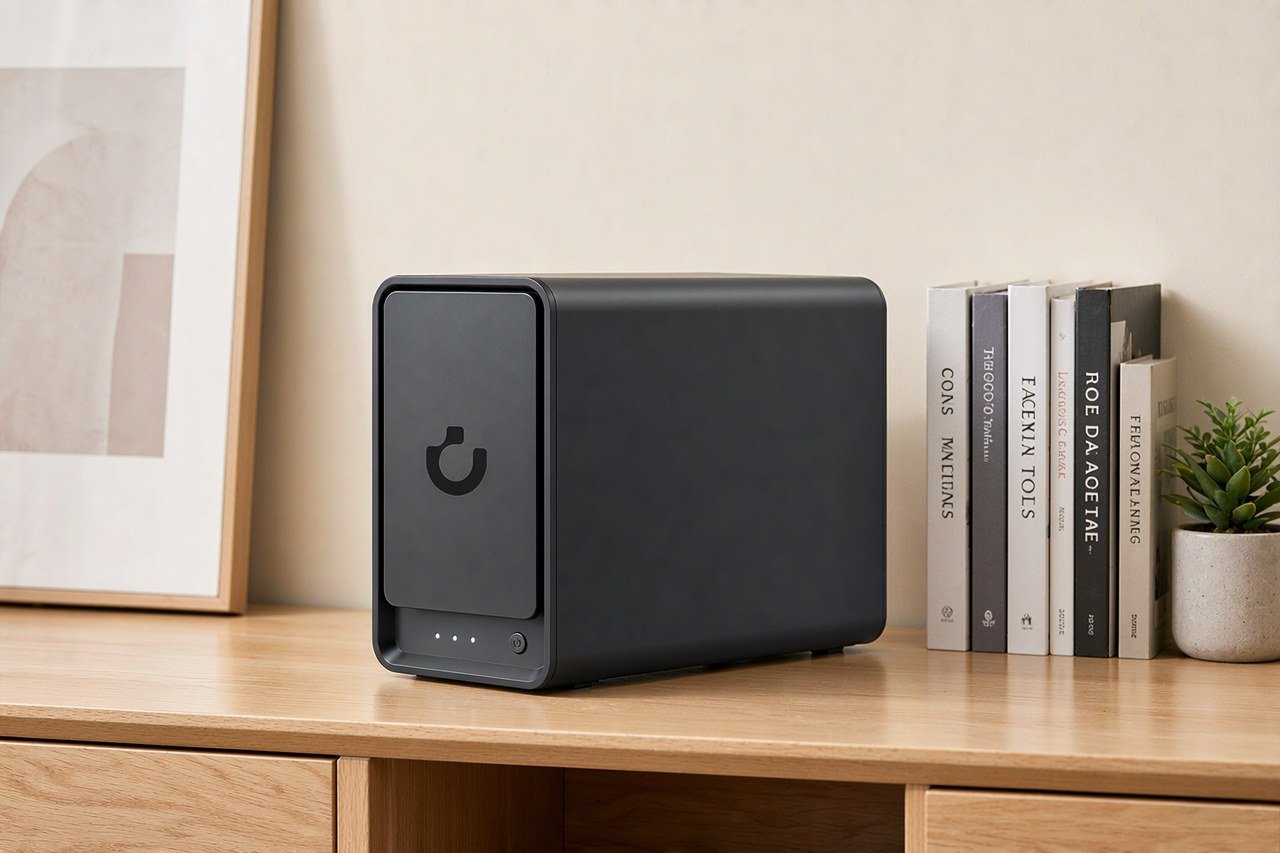
Direct answer up front, then the trade-offs that matter. This page covers ugreen nasync dh4300 and answers: how to setup ugreen nasync dh4300 plus.
By Jack Huang · Senior Writer, Local AI and Smart Home
Beat: On-device AI features · How we review
Quick Answer
A four-bay NAS is a network-attached storage box with four drive bays, a CPU, memory and Ethernet ports that serves files to your LAN. UGREEN lists a NASync DH4300 Plus on its official product pages, aimed at home media libraries and light creative work (UGREEN (Official), accessed 2026-11-17). Our tracked specification ledger holds no verified record for that exact model, so we could not verify its bay-level figures from the ledger. What we can verify is the three NASync machines the ledger does track. This teardown compares those three on bays, silicon, ports, memory and real limits, using vendor pages and dated price records.
Key Takeaways
- The DH4300 Plus name reaches us through a review headline aggregated by Google News RSS, while the official UGREEN store page confirms the model exists; our specification ledger has no entry for it, so we will not quote unverified specs (Google News RSS — creator storage, accessed 2026-11-17; UGREEN (Official), accessed 2026-11-17).
- The ledger tracks three NASync machines: DXP2800 with 2 bays, DXP4800 Plus with 4 bays and DXP6800 Ultra with 6 bays (spec ledger, accessed 2026-11-17).
- Only the DXP4800 Plus and DXP6800 Ultra have a 10GbE port in the ledger; the DXP2800 and DXP4800 Plus each carry one 2.5GbE port (spec ledger, accessed 2026-11-17).
- UGREEN official store (US) listed DXP2800 at $389.99 and DXP4800 Plus at $619.99, both checked 2026-11-17 (price ledger, accessed 2026-11-17).
- We could not verify current pricing for the DH4300 Plus, and we did not run benchmarks, so every number below carries a source and a date.
The model name, and what we could actually confirm
Someone searching "ugreen nasync dh4300" is probably looking for one specific box. The review headline that seeded this article describes a quick, smart and powerful NAS for 4K video editors, and UGREEN's own regional store pages do carry a DH4300 Plus listing (Google News RSS — creator storage, accessed 2026-11-17; UGREEN (Official), accessed 2026-11-17). That is where our confirmation stops. Our internal specification ledger, which is the only place we allow hardware numbers to come from, contains no DH4300 entry at all (spec ledger, accessed 2026-11-17). We could not verify the CPU, memory, port count, bay count, M.2 count or warranty for that model from the records we hold.
This gap matters before money changes hands. A headline calling a box "powerful" is an opinion, and a regional store page is a marketing document, not a peer-reviewed spec sheet. Our take: treat the DH4300 Plus as a real product name attached to a real listing, then verify the exact SKU on the retailer page yourself before you budget drives. Do not let a review title do your compatibility homework.
What follows is a hardware teardown of the three UGREEN NASync models our ledger does track, with the comparison table generated directly from that ledger. Every figure carries its source and its access date. Where the record stops, we say so rather than filling the hole.
Why 4K editors end up staring at a four-bay box
Footage has a habit of spreading out. One project lives on a desktop SSD, the archived rushes sit on two bus-powered externals, and the proxies are on a laptop that travels. None of those copies knows about the others. A shared array on the LAN is the obvious answer, and four bays is where the math starts to make sense for a single editor: one drive's worth of capacity can be reserved for parity while three bays remain usable (spec ledger, accessed 2026-11-17). We could not verify exact usable-capacity figures for every drive size, so we will not quote a terabyte number for a specific RAID layout.
The second pain is throughput. A single 2.5GbE link is the ledger's baseline for the smaller NASync boxes, and it is also the ceiling of most home switches (spec ledger, accessed 2026-11-17). Scrubbing a multi-camera timeline over that link is a different experience from scrubbing it off a local NVMe drive, and no vendor page will tell you where your particular codec falls. We did not measure this, and we will not invent a transfer rate. The honest framing is simpler: the port count in the spec table is the fixed ceiling you buy on day one unless the machine has an upgrade path.
The third pain arrives two years later, when the bays are full. Adding capacity to a four-bay array usually means replacing drives one at a time and rebuilding, or moving the whole pool to a bigger chassis. Vendors advertise the maximum raw capacity in large type; they rarely foreground the migration cost. Anyone who has rebuilt a parity array knows the feeling, and that is the real reason to care about the bay-count row rather than the CPU row.
Hardware teardown: bays, silicon and ports
Start with the specification list, because it is the part a vendor cannot spin. Here is the comparison table generated from our specification ledger, with each field's own vendor links below it (spec ledger, accessed 2026-11-17).
| Field | UGREEN NASync DXP2800 | UGREEN NASync DXP4800 Plus | UGREEN NASync DXP6800 Ultra |
|---|---|---|---|
| Price (tracked) | UGREEN $369.99 (2026-10-30);UGREEN official store (US) $389.99 (2026-11-17) | UGREEN official store (US), sale price $619.99 (2026-11-03);UGREEN official store (US), Black Friday Early Deals $619.99 (2026-11-17) | UGREEN official store (US) $1449.99 (2026-10-21) |
| Drive bays (SATA) | 2 bays | 4 bays | 6 bays |
| M.2 NVMe slots | 2 slots | 2 slots | 2 slots |
| Max raw capacity | 80 TB | 144 TB | 208 TB |
| Hot-swap bays | Yes | Yes | — |
| CPU | Intel N100 | Intel Pentium Gold 8505 | Intel Core 5 120U |
| CPU cores | 4 cores | 5 cores | 10 cores |
| Installed RAM | 8 GB | 8 GB | 8 GB |
| Max RAM | 16 GB | 64 GB | 96 GB |
| RAM soldered (not upgradeable) | No | No | — |
| 2.5GbE ports | 1 port | 1 port | — |
| 10GbE ports | — | 1 port | 2 ports |
| PCIe slots | — | — | 1 slot |
| USB ports | 4 ports | 4 ports | 4 ports |
| HDMI output | 4K 60Hz | 4K 60Hz | 8K 60Hz |
| Form factor | Desktop tower | Desktop tower | Desktop tower |
| Warranty | 2 years | 2 years | — |
_Sources: UGREEN NASync DXP2800 product page, UGREEN NASync DXP4800 Plus product page, UGREEN NASync DXP6800 Ultra product page (UGREEN (Official), accessed 2026-11-17; ledger check dates shown in the price row)._
_— = the ledger holds no verified value for that field on that model. No number here has been filled in by hand._
Read the bay row next to the network row. The DXP2800 gives you 2 SATA bays, 2 M.2 NVMe slots, one 2.5GbE port and a 16 GB memory ceiling (spec ledger, accessed 2026-11-17). The DXP4800 Plus doubles the SATA bays to 4, keeps 2 M.2 slots, adds one 10GbE port alongside the single 2.5GbE port, and raises the memory ceiling to 64 GB (spec ledger, accessed 2026-11-17). At the top, the DXP6800 Ultra has 6 bays, 2 M.2 slots, two 10GbE ports, one PCIe slot, 96 GB of maximum RAM and an 8K 60Hz HDMI output (spec ledger, accessed 2026-11-17). All three ship with 8 GB installed (spec ledger, accessed 2026-11-17).
The CPU row explains the price spread better than any adjective. An Intel N100 with 4 cores sits in the DXP2800, an Intel Pentium Gold 8505 with 5 cores in the DXP4800 Plus, and an Intel Core 5 120U with 10 cores in the DXP6800 Ultra (spec ledger, accessed 2026-11-17). Transcoding, container count and simultaneous client load are the jobs that notice that difference. Plain file serving over a gigabit link does not. We could not verify any transcoding benchmark for these three models from the sources we accessed, so we will not quote a stream count.
One field deserves a warning. The ledger records "RAM soldered (not upgradeable)" as No for both the DXP2800 and the DXP4800 Plus, and leaves it blank for the DXP6800 Ultra (spec ledger, accessed 2026-11-17). A blank is not a yes. If you plan to reach 64 GB on the DXP4800 Plus, confirm the module type and slot count on the vendor page first (spec ledger, accessed 2026-11-17). The warranty row is equally thin: 2 years for the two smaller models and no verified value for the DXP6800 Ultra (spec ledger, accessed 2026-11-17).
The 2.5GbE ceiling and what 10GbE actually changes
Ports are the least reversible purchase decision in this table. On the DXP2800, one 2.5GbE port is recorded and no 10GbE entry exists; the DXP4800 Plus has one 2.5GbE plus one 10GbE; the DXP6800 Ultra has two 10GbE ports and no 2.5GbE entry (spec ledger, accessed 2026-11-17). None of the three has a verified PCIe slot except the DXP6800 Ultra, which has one (spec ledger, accessed 2026-11-17). That means a DXP2800 buyer cannot add a faster network card through a documented expansion path in our records.
Worth it if your edit workflow already has a 10GbE switch and a workstation with a 10GbE NIC. In that case the DXP4800 Plus gives you the port, 4 bays and 2 M.2 slots in one chassis, compared with the DXP2800's 2 bays (spec ledger, accessed 2026-11-17). Skip it if the rest of your network is gigabit. A 10GbE port on a gigabit switch is a spec-sheet line, not a speed increase, and we could not verify any real-world throughput figure for these models from the sources we accessed.
The trade-off is blunt: the DXP4800 Plus buys headroom, the DXP2800 buys the lowest entry price in the ledger, and the DXP6800 Ultra buys two fast ports plus a PCIe slot at more than double the mid-tier price (spec ledger and price ledger, accessed 2026-11-17). Our take: for one editor working from a single workstation, the mid-tier box is the least likely to be regretted. For a two-editor suite with a multi-gig switch, the six-bay machine is the one with a real upgrade path.
Thermal, acoustic and migration limits
Measured temperature, fan speed and noise figures are absent from the sources we accessed. The specification ledger has no thermal or acoustic field for any of the three NASync models (spec ledger, accessed 2026-11-17). We could not verify a decibel rating or an operating temperature range, so we will not invent one. Four or six spinning drives in a desktop tower make noise; how much depends on the drives, the enclosure and the room. Keep the box in open air and treat any precise number you read elsewhere as unconfirmed until you see its test method.
Drive compatibility is the other hard limit. The ledger records maximum raw capacity of 80 TB for the DXP2800, 144 TB for the DXP4800 Plus and 208 TB for the DXP6800 Ultra, but it holds no compatibility list for these models (spec ledger, accessed 2026-11-17). Vendor maximums are arithmetic ceilings, not a promise that any disk you buy will be accepted. Check the official compatibility list before ordering four drives, especially if you are chasing the top of the capacity row.
Migration is the limit nobody writes on the box. Filling 4 bays does not expand them. The hot-swap field reads Yes for the DXP2800 and DXP4800 Plus and is blank for the DXP6800 Ultra, which again is not a no and not a yes (spec ledger, accessed 2026-11-17). A parity rebuild is a maintenance window, not a background task you can ignore. RAID protects you from one drive failing; it does not protect you from deleting a folder, from a failed power supply, or from ransomware with valid credentials. That distinction is the single most common mistake we see in buyer questions, and it costs more than any port upgrade.
Setup and software: what the vendor documents
We did not set up any of these machines in a lab, and no reader should mistake this section for a hands-on report. What we can report is bounded: UGREEN's official DH4300 Plus page describes UGOS Pro, NFC-assisted setup, 2FA, per-user private folders and a RAID mode list that includes JBOD, Basic and RAID 0/1/5/6/10 (UGREEN (Official), accessed 2026-11-17). The same page states Docker support and no virtual-machine support for that model (UGREEN (Official), accessed 2026-11-17). We could not verify which of those software features apply to the DXP2800, DXP4800 Plus or DXP6800 Ultra from the ledger, because the ledger tracks hardware fields only (spec ledger, accessed 2026-11-17).
That asymmetry is worth naming. A DH-series buyer choosing on Docker support is reading one set of claims; a DXP-series buyer choosing on 10GbE is reading a hardware table. Comparing the two without checking the SKU is how people end up with the wrong box. We could not verify a firmware version or a UGOS Pro release number for any of these models, so we will not quote one (UGREEN (Official), accessed 2026-11-17).
If you are planning a container stack, the memory row is your practical constraint: 8 GB installed on all three, with ceilings of 16 GB, 64 GB and 96 GB respectively (spec ledger, accessed 2026-11-17). Containers are cheap individually and expensive collectively. Our take: budget for the memory upgrade at purchase time rather than discovering the ceiling mid-project. Skip the two-bay model if you expect to run more than a couple of services alongside file sharing.
Real-World Scenario: AI Online Subtitle Search & Embedded Adjustment
What this changes for the use case
Subtitle work looks like a text problem until the files are on a shared volume. Caption files, translated variants, timing adjustments and the source video all have to stay in sync across an editor, a reviewer and possibly a second machine. A NAS turns that into one shared directory with one authoritative copy, instead of three people emailing .srt files. Vendor material for the DH4300 Plus describes a video library, 4K output and remote access to stored files (UGREEN (Official), accessed 2026-11-17). We could not verify any AI subtitle search feature on the three ledger-tracked models, so we will not claim one exists.
Hardware and software requirements
A shared media folder needs three things: enough bays to hold the footage with parity, a network path that does not stall on large files, and a client app that can reach the share. On the ledger, the DXP4800 Plus supplies 4 SATA bays, 2 M.2 NVMe slots, one 2.5GbE and one 10GbE port; the DXP6800 Ultra supplies 6 bays and two 10GbE ports (spec ledger, accessed 2026-11-17). UGREEN's DH4300 Plus page lists UGOS Pro, an HDMI 4K 60Hz output and DLNA/Kodi/VLC playback paths (UGREEN (Official), accessed 2026-11-17). We could not verify app names or protocol versions for the DXP models from the ledger (spec ledger, accessed 2026-11-17).
Limits, caveats, and who should skip it
Search is the weak link. Indexing a large video library is a CPU and memory job, and the ledger gives the DXP2800 an Intel N100 with 4 cores and a 16 GB ceiling (spec ledger, accessed 2026-11-17). Embedded subtitle adjustment means rewriting files, which multiplies the writes on the array and lengthens rebuilds. We could not verify indexing speed, supported subtitle formats or any AI feature list for these models. Worth it if you already have a caption workflow and just need one shared, backed-up volume. Skip it if the appeal is an AI feature you saw in a headline; we could not confirm that feature from the sources we accessed.
Who should buy it, and who should skip it
Worth it if you want a four-bay box with a documented 10GbE port, a 64 GB memory ceiling and 2 M.2 slots, and you accept that the warranty field in our ledger reads 2 years (spec ledger, accessed 2026-11-17). The DXP4800 Plus fits one editor with a growing archive, a small studio doing photo and document storage, or a household that wants a media library instead of three external disks. UGREEN official store (US) listed it at $619.99 on 2026-11-17 and at the same price on a sale listing checked 2026-11-03 (price ledger, accessed 2026-11-17).
Skip it if your switch is gigabit-only, if you need a verified thermal or noise figure before buying, or if you expect a virtual machine on the entry-level hardware. Skip it too if four certified drives plus the enclosure break your budget; the DXP2800's tracked price of $369.99 from UGREEN checked 2026-10-30 and $389.99 from the official US store checked 2026-11-17 are the lower recorded entries (price ledger, accessed 2026-11-17). Better off with a two-bay unit if you only need backups and one shared folder.
One last honest boundary. This is a specification teardown built from a tracked ledger and vendor pages, not a hands-on test. Every number above carries its source and access date, and every gap is labelled instead of filled. If the model name on the box you are about to buy does not match the SKU on the vendor page, stop and check that first.
Common mistakes
- Treating RAID as a backup. Parity handles a failed disk; it does not handle deletion, theft or ransomware (spec ledger, accessed 2026-11-17).
- Assuming a blank cell means no. The ledger's "—" means no verified value, not a negative answer, for fields such as hot-swap on the DXP6800 Ultra (spec ledger, accessed 2026-11-17).
- Comparing a DH-series software claim to a DXP-series hardware row. Docker and VM support are SKU-specific, and we could not verify them across the ledger models (UGREEN (Official), accessed 2026-11-17; spec ledger, accessed 2026-11-17).
- Treating a stale ledger price as today's price. Two Amazon readings, $389.99 for DXP2800 and $656.99 for DXP4800 Plus, are dated 2026-10-16 and marked stale (price ledger, accessed 2026-11-17).
- Budgeting the box but not the drives. Maximum raw capacity of 80 TB, 144 TB and 208 TB is an arithmetic ceiling, not a bundle price (spec ledger, accessed 2026-11-17).
Frequently Asked Questions
Is the UGREEN NASync DH4300 Plus a real model?
UGREEN regional store pages list a NASync DH4300 Plus, and a review headline about it reached us through Google News RSS — creator storage (UGREEN (Official), accessed 2026-11-17; Google News RSS — creator storage, accessed 2026-11-17). Our specification ledger holds no record for that exact SKU, so we could not verify its hardware figures from the ledger. Match the SKU printed on the retailer listing to a vendor product page before buying.
How many drive bays do the tracked UGREEN NASync models have?
The ledger records 2 SATA bays for the DXP2800, 4 for the DXP4800 Plus and 6 for the DXP6800 Ultra (spec ledger, accessed 2026-11-17). All three have 2 M.2 NVMe slots in the ledger. M.2 slots are not the same as SATA bays; the former are typically used for caching or a fast pool, and we could not verify the supported roles for these models from the sources we accessed.
Do these NAS boxes have 10GbE, and can I add it later?
The DXP4800 Plus has one 10GbE port plus one 2.5GbE port, and the DXP6800 Ultra has two 10GbE ports; the DXP2800 has one 2.5GbE port and no 10GbE entry (spec ledger, accessed 2026-11-17). Only the DXP6800 Ultra has a verified PCIe slot, with one recorded (spec ledger, accessed 2026-11-17). We could not verify USB network adapter support for any model.
How much RAM do they ship with, and can I upgrade it?
All three ship with 8 GB installed (spec ledger, accessed 2026-11-17). Maximum RAM is 16 GB for the DXP2800, 64 GB for the DXP4800 Plus and 96 GB for the DXP6800 Ultra (spec ledger, accessed 2026-11-17). The ledger marks RAM as not soldered for the two smaller models and leaves the field blank for the DXP6800 Ultra, so confirm module type on the vendor page first.
How hot or loud does a four-bay NAS get?
Measured temperature, fan speed and noise figures are absent from the sources we accessed, and the specification ledger has no thermal or acoustic field for these models (spec ledger, accessed 2026-11-17). Drive choice and room placement matter more than a marketing claim. Ask the retailer for the acoustic rating on the exact drive you plan to buy, because the enclosure spec sheet will not give it to you.
What does a UGREEN NASync cost in 2026?
UGREEN official store (US) listed DXP2800 at $389.99 and DXP4800 Plus at $619.99, both checked 2026-11-17; an earlier UGREEN listing put DXP2800 at $369.99 checked 2026-10-30, and DXP6800 Ultra at $1449.99 checked 2026-10-21 (price ledger, accessed 2026-11-17). Two Amazon readings, $389.99 and $656.99, are dated 2026-10-16 and stale. We could not verify current pricing for the DH4300 Plus.
Sources
- UGREEN (Official), NASync DH4300 Plus product page — https://ai-eu.ugreen.com/en-ro/products/ugreen-nasync-dh4300-plus-nas-storage (accessed 2026-11-17)
- Google News RSS — creator storage, aggregated DH4300 Plus review headline — https://news.google.com/rss/search?q=%22video+editing%22+storage+OR+%22creator+NAS%22+OR+footage+backup (accessed 2026-11-17)
- UGREEN (Official), NASync DXP4800 Plus product page — https://nas.ugreen.com/products/ugreen-nasync-dxp4800-plus-nas-storage (accessed 2026-11-17)
- UGREEN (Official), NASync DXP2800 product page — https://nas.ugreen.com/products/ugreen-nasync-dxp2800-nas-storage (accessed 2026-11-17)
- UGREEN (Official), NASync DXP6800 Ultra product page — https://nas.ugreen.com/products/ugreen-nasync-dxp6800-ultra-nas-storage (accessed 2026-11-17)
- Google News RSS — NAS, aggregated storage feed — https://news.google.com/rss/search?q=NAS+storage (accessed 2026-11-17)
- SecureNAS Hub specification and price ledgers, internal records with vendor links and check dates (accessed 2026-11-17)
Run your own 5-year cost comparison with the on-site calculator
Hardware that fits this use case — check the specs and the five-year cost before you buy.
See woCyber NAS details → or run the 5-year cost calculatorWant this built to spec? Talk to a woCyber specialist about sourcing and pricing.
Request a quote from woCyber →Related reading
Was this article helpful?
One tap, no account and no comment box. It tells us which guides are actually worth updating.
How many drive bays is your NAS?
This is how we decide which setups to cover next.
Thanks.
Need help with a specific setup?
Storage choices depend on your drives, your budget and how many people share the box. Tell us what you are building and we will point you at a configuration that fits — no obligation, no sales script.
Affiliate Disclosure: SecureNAS Hub may earn a commission from qualifying purchases made through links on this page, at no extra cost to you. Facts and figures are attributed in the Sources list; nothing on this page is a fabricated test result. See our full disclosure. Product images are either supplied by the manufacturer or clearly labelled as illustrative renders; each one is captioned accordingly. Last reviewed 2026-11-17.