NAS Guides · Published 2026-09-29
Beelink ME Pro Panther Lake NAS: Local AI and Storage
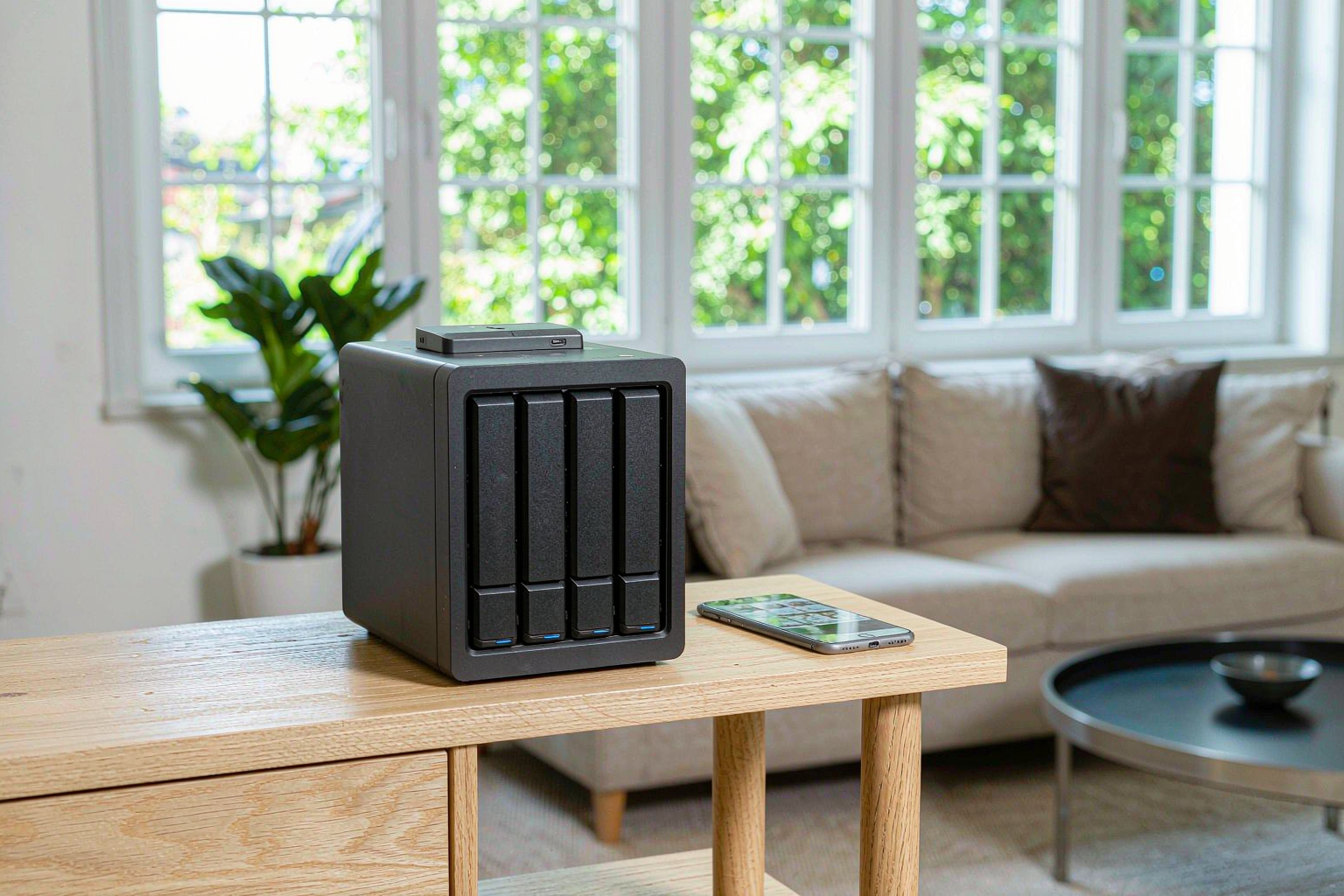
Direct answer up front, then the trade-offs that matter. This page covers lake with nas storage and answers: What is a NAS and do I need one?.
By Konpin · Founder / Lead Analyst
Beat: Private-cloud economics · How we review
Quick Answer
Beelink has shown a Panther Lake generation of its ME Pro, a box that acts as both a compact desktop PC and a network-attached storage (NAS) device. Two processors are confirmed — the Intel Core Ultra X7 358H and the Core Ultra 5 325 — and the software bundle pairs Tencent's Marvis agent with the fnOS storage operating system (Guru3D, accessed 2026-09-29). Beelink says the family arrives before the end of October 2026, but it has published no price, no drive-bay count and no network specification for these units (Notebookcheck, accessed 2026-09-29). Treat this as a preview to evaluate, not a product to order.
Key Takeaways
- Beelink previewed the Panther Lake ME Pro at the Intel Connection 2026 event in China, with availability targeted before the end of October 2026 (Guru3D, accessed 2026-09-29).
- Two chips are confirmed: the Core Ultra X7 358H, a 16-core part with Arc B390 integrated graphics, and the Core Ultra 5 325, which carries a smaller four-core Xe3 GPU (Notebookcheck, accessed 2026-09-29).
- The software is the real differentiator and the biggest unknown. Chinese units ship with Tencent's Marvis agent and the fnOS platform; whether those features reach international stock is still unconfirmed (MangoDeveloper, accessed 2026-09-29).
- No price, bay count, RAID mode list or network specification has been published for the Panther Lake models, so any figure circulating today is extrapolated from earlier ME Pro versions (Guru3D, accessed 2026-09-29).
- Earlier ME Pro models bracket the likely range: Beelink's store lists the two-bay N95/N150 version at $559, and the AMD Ryzen AI 9 HX 370 barebone opened at ¥3,999, about $590, in China (Beelink; Notebookcheck, accessed 2026-09-29).
- The swappable chassis is a separate, already-advertised feature: Beelink markets a drawer-style motherboard design that accepts Intel, AMD or Arm boards (TechPowerUp, accessed 2026-09-29).
How It Works
What Beelink announced, and when
Beelink used the Intel Connection 2026 conference in China to show a Panther Lake generation of the ME Pro, its hybrid desktop-and-storage box. Panther Lake is Intel's third-generation Core Ultra platform, and Beelink is offering it in two tiers. Reports from the event name the Core Ultra X7 358H at the top of the stack and the Core Ultra 5 325 below it (Guru3D, accessed 2026-09-29).
Notebookcheck adds two details that matter more than the branding. First, it expects three body styles: the familiar two-bay and four-bay chassis, plus a compact unit that may be an all-flash design, similar in concept to Minisforum's S5. Second, it describes the X7 358H as a 16-core processor with Arc B390 graphics, while the Core Ultra 5 325 makes do with a four-core Xe3 GPU (Notebookcheck, accessed 2026-09-29).
"Previewed" is the operative word. No specification sheet exists yet, and Beelink has not published sustained power limits or cooling details either. Those are exactly the numbers you need to judge whether a fast mobile chip inside a small storage chassis holds its clocks under load or throttles back the moment the drives start writing (Guru3D, accessed 2026-09-29).
Why a storage box gets gaming-class graphics
Putting Arc-class graphics and sixteen cores into a storage appliance looks like overkill until you look at what the software is meant to do. Tencent's Marvis is described as an operating-system-level personal agent that understands file contents, controls other devices remotely and can process data locally. The fnOS platform, from Feiniu, covers the traditional storage jobs: file management, backup synchronisation, remote access, and browsing or sharing video held on the device (Guru3D; PC Central, accessed 2026-09-29).
Content indexing is the workload that justifies the silicon. Searching a decade of footage by describing what happens in it is a machine-learning task, and running it on the box keeps that footage off someone else's servers. That is a genuine argument for local processing, but Guru3D raises a caveat worth carrying forward: privacy here depends on the exact software configuration and on whether individual features contact cloud services (accessed 2026-09-29). Local-AI branding is not the same thing as a local-only pipeline, and the only way to settle it is to read the privacy documentation for the SKU you can actually buy.
MangoDeveloper makes a related point about where this could go wrong. Chinese units ship with fnOS and Marvis; whether the international version arrives with the same stack, a reduced one, or a plain Linux install has not been confirmed (accessed 2026-09-29). Buy the hardware for the hardware, and treat the AI features as a bonus that still has to be verified on your regional model.
The appliance problem nobody has solved yet
A NAS is judged on uptime; a mini PC is judged on burst speed. Merging them puts a heat source with rapidly changing output directly beside drives that want stable airflow, and independent testing will need to measure drive temperatures, fan noise, and whether CPU-heavy work slows storage performance (Guru3D, accessed 2026-09-29). Beelink's own figures for an earlier AMD ME Pro claim CPU temperatures near 41 °C and drive temperatures near 43 °C under load, but those are vendor numbers for a different board, not measurements of the Panther Lake unit (Notebookcheck, accessed 2026-09-29).
What to Look For
Drive bays, expansion and the honest capacity ceiling
With no published specification for the new units, the closest reference is the ME Pro already on sale. Beelink's own store lists the two-bay N95/N150 model with two 2.5- or 3.5-inch SATA bays taking up to 30TB per drive, plus three M.2 NVMe slots rated at 4TB each, for an advertised total of 72TB (accessed 2026-09-29). The AMD Ryzen AI 9 HX 370 version is sold in two-bay and four-bay forms, marketed at 72TB and 132TB respectively (Notebookcheck, accessed 2026-09-29).
Two lessons carry over. Advertised totals are raw sums rather than usable space, because parity, filesystem overhead and reserved blocks all take a bite, and mixing mirrors with parity arrays changes the arithmetic again. Plan around usable capacity and a second copy elsewhere, not around the largest number on the product page.
Local AI indexing — what it can and cannot do
Indexing photographs by face, place and object is a solved problem on modest hardware; describing video content in natural language is heavier. That gap is why the X7 358H exists in this lineup at all, and it is also why the cheaper Core Ultra 5 325 with its smaller GPU will feel different in daily use. If your library is mostly documents and stills, the faster chip buys you very little. If you shoot long-form video and want to search it by describing the scene, the GPU tier is the specification that decides whether the feature is pleasant or unusable.
One honest limitation applies either way. Beelink has not said how much memory the Panther Lake units carry, and the announcement does not establish whether memory is replaceable or soldered (Guru3D, accessed 2026-09-29). Local AI workloads are frequently memory-bound, so this single unknown can matter more than the processor choice.
Networking and backup automation
A hybrid with a 10-core-class CPU and no multi-gigabit network is a sports car in a car park. Earlier ME Pro versions ship with one 10GbE and one 2.5GbE port, or a 5GbE and 2.5GbE pairing depending on the board (Notebookcheck; Beelink, accessed 2026-09-29). Wait for the network specification before assuming the Panther Lake models inherit either arrangement.
On the software side, fnOS is said to provide file management, backup synchronisation and remote access, while Marvis adds cross-device control (Guru3D, accessed 2026-09-29). Snapshot support, disk-health monitoring, remote-access security and recovery behaviour are the four things to check before you trust important data to any new platform, hybrid or not.
Noise, power and thermals
Compact chassis designs trade quiet for small. The current two-bay ME Pro measures roughly 166 × 121 × 112 mm and uses an aluminium frame with an internal blower and silicone dampers to keep drive vibration down (Beelink, accessed 2026-09-29). A 16-core Panther Lake chip in that footprint will produce more heat than the N-series CPUs the design was drawn around, and neither power draw nor cooling has been published. Idle power matters too, because a device left on for years spends most of its life doing nothing in particular.
Real-World Costs
No price has been announced for the Panther Lake models. The table below is context from the ME Pro line as it stands, and every currency conversion is the reporting outlet's own approximation rather than an official dollar price. Treat these as a shape, not a quote.
| ME Pro variant | Configuration | Reported price | Source (accessed 2026-09-29) |
|---|---|---|---|
| N95/N150, two-bay (global) | 12–16GB LPDDR5 plus SSD options | $559 list; promoted at $369 | Beelink store |
| Core i5-13500H, 2+4 bays (China) | Barebone | ¥2,569, about $378 | PC Central |
| Ryzen 7 H 255, four-bay (China) | Barebone / 32GB + 500GB | ¥2,739 (about $403) / ¥5,599 (about $824) | Notebookcheck |
| Ryzen AI 9 HX 370, two-bay (China) | Barebone / 32GB + 500GB | ¥3,999 (about $590) / ¥7,495 (about $1,107) | Notebookcheck |
| Core Ultra X7 358H, two- and four-bay | Panther Lake preview | Not announced | Guru3D |
Three things are worth reading out of that table. First, barebone pricing is the number that matters when you already own drives, and it is consistently far below the configured versions — the gap between the Ryzen AI 9 HX 370 barebone and its 32GB/500GB sibling is roughly $500. Second, drives are not included in any barebone figure, and on a two-bay unit the drives can easily cost as much as the enclosure. Third, a hybrid is not automatically cheaper than separate boxes: the honest comparison is a small NAS plus a mini PC against one ME Pro, and the answer depends on whether you actually need the compute next to the storage.
For a longer view, put the headline price beside a five-year cloud subscription of the same capacity. Our five-year cost calculator runs that comparison, and compared with paying monthly for the same space, most households reach the crossover well inside the first subscription cycle — but only if you would otherwise be buying that much cloud storage.
Recommended Setups
Budget setup
If the point is storage rather than compute, the entry path is a two-bay ME Pro with CMR drives in a mirror, or a conventional NAS if the hybrid premium turns out to be real. Buy capacity for the next two years. When your library has genuinely outgrown a single drive, start from our round-up of the best private cloud NAS options for 2026 — the size of the library, not the processor, should decide the purchase.
Family setup
Four bays with single-parity protection, sized from the photos, documents and phone backups you already own. A hybrid earns its place here if several people want to edit or stream from the same library, because the integrated GPU handles transcoding without a second machine. Keep a second copy somewhere else: parity protects against a failed drive, not against a deleted folder or a stolen box.
Creator setup
This is the configuration the Panther Lake ME Pro is really aimed at: a faster CPU tier for indexing and transcoding, multi-gigabit networking so the array is not the bottleneck, and enough bays to stage footage locally before archiving. Before choosing an enclosure on those grounds, compare the trade-offs in our guide to the best NAS for content creators, and decide whether the local-AI features are worth paying for given that they are unproven outside China.
Common Mistakes
- Assuming the AI features ship everywhere. The Chinese SKU carries fnOS and Marvis; the international configuration has not been confirmed, and the hardware's AI capability is only as useful as the software that arrives with it (MangoDeveloper, accessed 2026-09-29).
- Buying on the processor alone. Bay count, RAID support, network speed and memory configuration are all still unpublished for the Panther Lake units, and any of them can disqualify the product for your use case.
- Treating a hybrid as a backup. RAID is availability, not backup. A single enclosure holding both the original and the only copy is a single point of failure regardless of how many drives are inside.
- Ignoring thermals and idle power. A high-power chip in a compact chassis is a thermal question, and a machine that runs for five years is judged on its idle draw as much as its peak speed.
- Pre-ordering a preview. Nothing about this announcement is priced or specified yet. Waiting costs you nothing except novelty.
Frequently Asked Questions
What is the Beelink ME Pro?
The ME Pro is Beelink's hybrid device that combines a mini PC with a multi-bay NAS in one chassis, so a single box provides desktop compute and shared storage. The version announced in September 2026 runs on Intel's Panther Lake platform with a Core Ultra X7 358H or Core Ultra 5 325 processor, paired with Tencent's Marvis agent and the fnOS storage operating system (Guru3D, accessed 2026-09-29).
When does the Panther Lake ME Pro go on sale, and how much will it cost?
Beelink's stated target is before the end of October 2026, and Notebookcheck reports the launch is set for October (accessed 2026-09-29). No price has been announced for any Panther Lake configuration. Earlier ME Pro barebones have opened between roughly ¥2,569 and ¥3,999 in China, which is about $378 to $590 at the conversions those outlets used, but that range is not a forecast (PC Central; Notebookcheck, accessed 2026-09-29).
Is the Beelink ME Pro a NAS or a mini PC?
It is deliberately both. The chassis holds SATA drive bays and runs storage software, which makes it a NAS; it also drives displays, has desktop-class CPU options, and can be used as an ordinary computer. That dual role is the reason the thermal design is the most important thing to assess before buying (TechPowerUp, accessed 2026-09-29).
Will the Tencent Marvis AI features be available outside China?
That is unconfirmed, and it is the single biggest open question about the product. The Chinese units ship with fnOS and Marvis, and reporting from the announcement notes that it is unclear whether those features launch internationally in October; if an international unit ships with a bare operating system, the local-AI capability becomes a DIY project rather than an appliance feature (MangoDeveloper, accessed 2026-09-29).
How many drive bays does the Panther Lake ME Pro have?
Beelink has not said. Notebookcheck expects three body styles — two-bay and four-bay versions plus a compact model that may be all-flash — but that is a report from the event rather than a published specification (accessed 2026-09-29). Earlier ME Pro variants use two or four SATA bays alongside three or four M.2 slots, and those are the numbers worth treating as a placeholder until Beelink publishes the real sheet.
Can a NAS replace cloud storage?
For photos, documents and media, usually yes, and at far lower long-run cost once the hardware is paid for — the trade-off is that you own the maintenance, the backups and the failure risk. A NAS does not remove the need for an off-site copy, so the fair comparison is local hardware plus a small backup subscription against a large cloud plan. Guru3D's reporting also notes that whether local AI processing truly keeps data on your device depends on how the software is configured and whether individual features call out to remote services (accessed 2026-09-29).
Sources
- Beelink intros powerful Panther Lake-equipped ME Pro NAS lineup — Notebookcheck — https://www.notebookcheck.net/Beelink-intros-powerful-Panther-Lake-equipped-ME-Pro-NAS-lineup.1406443.0.html (accessed 2026-09-29)
- Beelink ME Pro Teaser Showcases DIY Swappable AMD, Arm, & Intel Board System — TechPowerUp — https://techpowerup.com/344145/beelink-me-pro-teaser-showcases-diy-swappable-amd-arm-intel-board-system (accessed 2026-09-29)
- Beelink ME Pro Combines Panther Lake With NAS Storage and Local AI Software — Guru3D — https://www.guru3d.com/story/beelink-me-pro-combines-panther-lake-with-nas-storage-and-local-ai-software (accessed 2026-09-29)
- Beelink ME Pro NAS Gets Panther Lake AI Chips for 2026 — PC Central — https://pccentral.net/beelink-me-pro-nas-panther-lake-ai-chips-2026 (accessed 2026-09-29)
- Beelink ME Pro NAS Swaps to Panther Lake, Adds Arc B390 for Local AI — MangoDeveloper — https://mangodeveloper.com/articles/beelink-me-pro-nas-swaps-to-panther-lake-adds-arc-b390-for-local-ai (accessed 2026-09-29)
- Affordable AMD-powered Beelink NAS launches with 136TB storage support — Notebookcheck — https://www.notebookcheck.net/Affordable-AMD-powered-Beelink-NAS-launches-with-136TB-storage-support.1332539.0.html (accessed 2026-09-29)
- Beelink ME Pro 2-Bay Hybrid NAS Mini PC, Intel N95/N150 — Beelink official store — https://www.bee-link.com/products/beelink-me-pro (accessed 2026-09-29)
- 零刻公布 Panther Lake 款 ME Pro NAS 迷你主机, 支持多项 AI 应用 — IT之家, via Sohu — https://www.sohu.com/a/1079635448_114760 (accessed 2026-09-29)
Run your own 5-year cost comparison with the on-site calculator
与合作方产品高度相关(标签:nas-hardware)
See woCyber NAS details → or run the 5-year cost calculatorRelated reading
Affiliate Disclosure: SecureNAS Hub may earn a commission from qualifying purchases made through links on this page, at no extra cost to you. Facts and figures are attributed in the Sources list; nothing on this page is a fabricated test result. See our full disclosure. Product images, where shown, are supplied by manufacturers. Last reviewed 2026-09-29.