Backup & Privacy · Published 2026-10-01
Apple Watch Privacy Settings vs Local Storage: Where Files Live
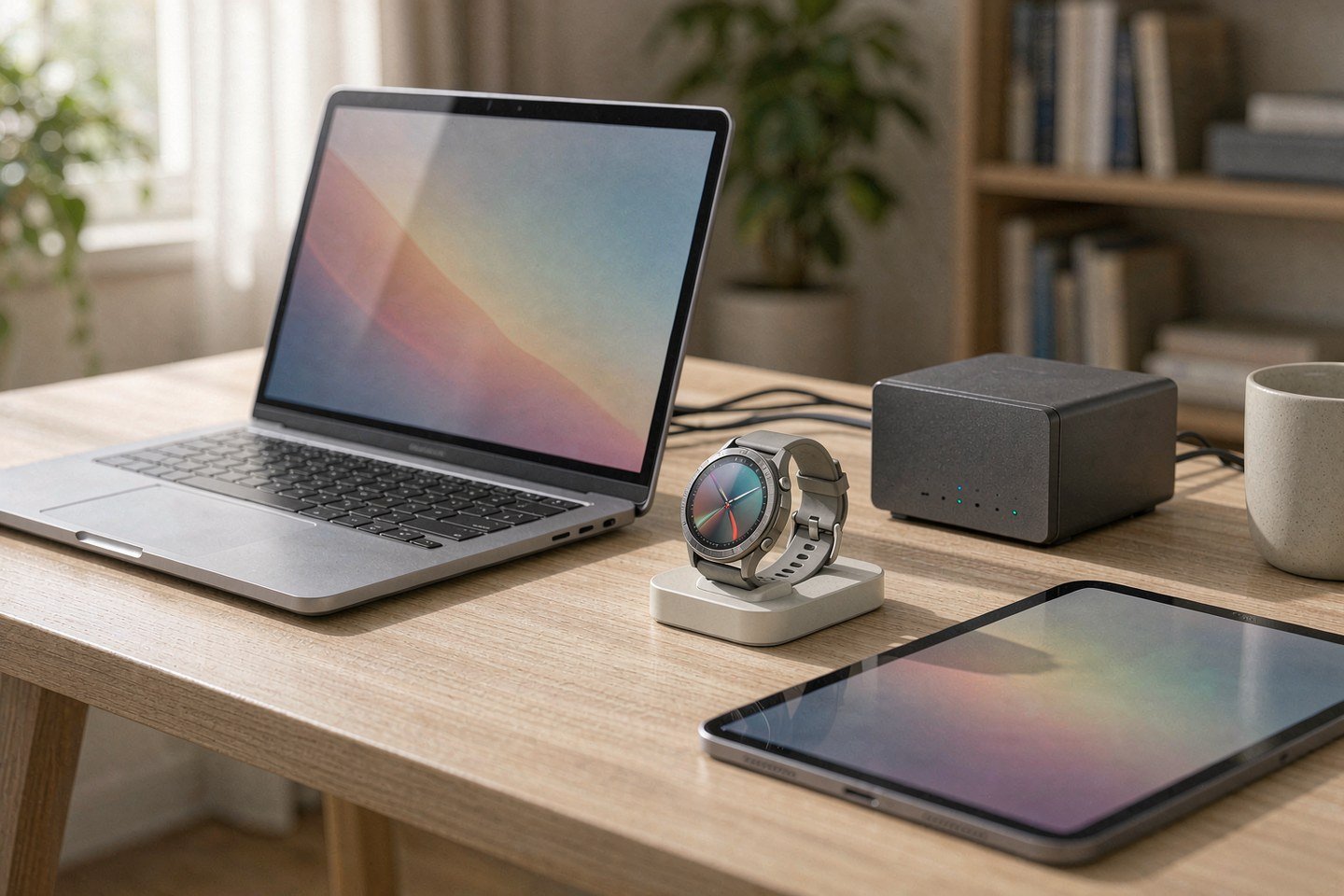
Direct answer up front, then the trade-offs that matter. This page covers apple watch privacy and answers: How do I secure a NAS on my network?.
By Lillian · Senior Editor, Buying Guides
Beat: Buying guides · How we review
Quick Answer
Apple's Watch Series 12 turned "where do my files live" into a launch-week controversy. The new Audio Intelligence suite — Siri Recap and Live Rewind in particular — processes nearby conversation audio in a protected buffer on the S11 chip, and the summaries it produces sync through end-to-end-encrypted iCloud storage that auto-deletes after seven days unless you save them. Saving is the pivot: the moment a recap lands in Notes, Journal, or iCloud, it becomes a durable file tied to your Apple ID, not an ephemeral trace on your wrist. This guide maps every stop your Apple Watch data can make, then shows how a local-first setup changes the answer for households and creators who want the archive under their own roof.
Key Takeaways
- Audio Intelligence is opt-in everywhere: Live Rewind only runs on a double-press of the Digital Crown, and Siri Recap runs on a schedule you set or a manual toggle in Control Center.
- Raw audio never becomes a recording; it lives in a continuously overwritten buffer inside the S11's Secure Exclave that the OS, apps, you, and Apple cannot reach.
- Siri Recap summaries sync end-to-end-encrypted through iCloud and vanish after seven days unless you explicitly save them — saved copies sit in Apple's cloud indefinitely.
- The watch itself cannot be made fully local: setup requires an Apple ID, and sync depends on iCloud. What you can localize is the archive — exports, saved recaps, and health data you pull onto a NAS you control.
- Series 12 starts at $399 (aluminum), launched September 18, and the two conversation-listening features are still beta software that skips the EU at first release.
What Apple Announced, and Why the Privacy Debate Took Over
The Series 12 arrived on September 9 with a new S11 chip, a redesigned health-sensor array, and the familiar $399 aluminum starting price — titanium at $699, returning ceramic at $899. The feature Apple spent the most stage time on was Audio Intelligence, a four-part suite: Sound Recognition alerts, Music Recognition via Shazam, Live Rewind, and Siri Recap.
The last two are the contentious ones. Live Rewind shows a text snippet of the last 15 seconds of speech when you double-press the Digital Crown; it plays an audible chime and flashes a visual indicator so people nearby know it ran. Siri Recap listens across the day, on your schedule, and drops AI-generated conversation summaries into the Siri app. Both ship in beta "later this year," English first, and neither is available in the EU at launch.
Reviewers liked the hardware but flagged the microphone. WIRED's verdict listed "privacy concerns around Siri Recap and Live Rewind" among its TIRED points, and a PCMag opinion column called the concept "mass surveillance in a watch." The launch-weekend conversation was dominated less by the new sensor array than by the question of who can hear whom.
Where Your Apple Watch Files Actually Live
Strip away the keynote language and Apple Watch privacy comes down to three distinct storage tiers, each with very different rules.
Tier 1 — the ephemeral buffer. When any Audio Intelligence feature is active, microphone audio flows into the Secure Exclave on the S11 chip. Apple's privacy paper describes a continuously overwritten stream: old audio is replaced by new audio, raw audio never accumulates, and no recording exists that the operating system, an app, the user, or Apple could pull back out. This tier is genuinely local — there is simply no file to move.
Tier 2 — encrypted iCloud with a timer. A Siri Recap summary that you review but do not save syncs across your devices through iCloud with end-to-end encryption, so only your trusted devices can decrypt it. Unsaved recaps automatically disappear after seven days. This is cloud storage, but tightly scoped.
Tier 3 — saved copies. The moment you save a recap or export it, the file lands in iCloud and can surface in Apple Notes, Journal, or any app you send it to. Retention becomes indefinite, and the effective security boundary shifts from Apple's servers to your Apple ID: an account-level compromise, a phished password, or an unlocked phone exposes every saved summary in one place. Security commentators who covered the launch noted that credential compromise, not a breach of Apple's infrastructure, is the realistic exposure path for most people.
| Data | Default home | Retention | What local-first changes |
|---|---|---|---|
| Live Rewind audio | S11 Secure Exclave buffer | Overwritten continuously; nothing stored | Nothing to move — it never becomes a file |
| Unsaved Siri Recap | Siri app via end-to-end-encrypted iCloud | Auto-deletes in 7 days | scoped cloud copy you can let expire |
| Saved recaps / exports | iCloud, Notes, Journal | Indefinite, tied to your Apple ID | Move the archive to storage you control |
| Health metrics | iPhone Health app, iCloud backup | Follows your account indefinitely | Periodic encrypted backups to a home NAS |
The practical takeaway: Apple Watch privacy settings decide how much gets created, but only your storage choices decide where the durable copies end up.
What It Means for Home and Creator Storage
If you run a household or a small studio, the Series 12 debate is a rehearsal for a decision you will keep making: convenience features generate files, and files need a home you trust.
Three moves cover most of it. First, leave the listening features off until you actually want them — every Audio Intelligence capability is opt-in, so a new watch does not start eavesdropping on its own. Second, treat saved recaps like any other document: if a conversation summary matters (a client brief, a contractor quote, a doctor's instruction), export it deliberately and file it where your backups run. Third, fold wearable data into your existing local-first pipeline. The Health app already exports your full history as a file, and that export — with years of heart-rate, sleep, and workout data — is exactly the kind of archive that belongs on a mirrored NAS volume rather than only in someone else's cloud.
This is the same pattern we saw when an automated attack deleted more than a hundred cloud storage accounts in minutes: anything that lives solely in a hosted account can vanish on someone else's schedule. A two-drive mirrored NAS with encrypted shares turns "my archive is wherever the vendor says" into "my archive is on hardware I can touch." It is also the same instinct behind a privacy-first phone that left the Pixel bubble — keep the sensor in the ecosystem, keep the memory in your basement.
What to Watch: the Limits and Open Questions
Be honest about what local storage does not fix. The watch and iPhone require an Apple ID to set up, and Audio Intelligence summaries are born in Apple's cloud pipeline before you can ever export them — there is no setting that routes a recap straight to your NAS. The listening features are beta software that skips the EU at launch, so availability and behavior may shift before the general release. And consent remains unsettled: in US states and countries with all-party recording-consent rules, a microphone that runs on a schedule in a shared room is exactly the kind of thing lawmakers have not caught up to, recording or no recording.
There is also a responsibility trade. A local archive means you own redundancy, encryption, and off-site copies. If you keep saved recaps on a NAS with no backup, you have traded a vendor's seven-day timer for a single drive failure.
Real-World Scenario: Pure Local Offline Account & Absolute Privacy Isolation
What this changes for the use case
In this setup, the Apple Watch stays a sensor and your network holds the memory. Recaps you want to keep, health exports, and any voice-derived text get pulled off the iPhone onto a home server running under a local account that has no cloud relationship at all. The archive is reachable over your LAN or a VPN, works with the internet down, and never appears in a vendor's data center. The privacy boundary becomes your router, not a terms-of-service document — the same isolation logic that drives offline-first NAS accounts.
Hardware and software requirements
You need a NAS with at least two drives in a mirrored layout, encrypted shared folders, and a private sync endpoint such as Synology Drive or a self-hosted Nextcloud instance. On the phone side, plan a routine: Health app exports and saved recap text saved as files, then moved over your LAN rather than through a public link. Add two-factor authentication on the NAS itself, a dedicated user for the archive that has no external access, and a scheduled encrypted backup to a second target so a single disk failure cannot take the wearable history with it.
Limits, caveats, and who should skip it
You cannot make the watch itself local — Apple's ecosystem requires the Apple ID, and the Audio Intelligence pipeline starts on Apple's infrastructure no matter what you do downstream. If you never save recaps, there is nothing to export and this whole exercise buys you little beyond health-data backups. And a purely local archive is on you: miss the offsite copy and a house fire does what a cloud outage never could. Skip this setup if you rarely save summaries, or hand the backup duty to a trusted cloud service instead and accept the trade.
Frequently Asked Questions
Do the Series 12 listening features record my conversations?
No. Apple's documentation states that Audio Intelligence does not create audio recordings; microphone audio sits in a hardware-protected buffer that is continuously overwritten and inaccessible to the operating system, apps, or Apple itself. Only text summaries are produced, and only for features you enable.
Is Siri Recap on by default?
No. Every Audio Intelligence feature is opt-in. Siri Recap only runs when you enable it in the iPhone Watch app, and you can constrain it to a time-and-location schedule — or switch it off instantly from Control Center.
Can I run an Apple Watch without iCloud?
Not entirely. Setup requires an Apple ID, and several features depend on iCloud sync. What you control is what gets kept: let unsaved recaps expire, avoid saving summaries to Notes, and move the data you do want — health exports, saved text — onto local storage you manage.
How do I move Apple Watch data to a NAS?
Export it as files. The Health app produces a full-history export file, and saved recaps can be copied out of Notes or the Siri app as text. Move those files over your LAN to an encrypted NAS share, and include that share in your regular encrypted backup schedule.
Sources
- Apple details how Apple Watch's new Audio Intelligence features work in privacy paper — https://9to5mac.com/2026/09/09/apple-details-how-apple-watchs-new-audio-intelligence-features-work-in-privacy-paper/ (accessed 2026-10-01)
- Apple Watch Series 12 has an always-on Siri that makes AI recaps of your day — https://www.theverge.com/tech/991812/apple-watch-series-12-announcement (accessed 2026-10-01)
- The Apple Watch Series 12 is the start of a new wearable era — https://www.theverge.com/tech/996715/apple-watch-series-12-review-wearables-smartwatch (accessed 2026-10-01)
- Review: Apple Watch Series 12 — https://www.wired.com/review/apple-watch-series-12 (accessed 2026-10-01)
- Apple Watch Series 12 Reviews Are In: Health Sensing Praised, but Siri Recaps Controversy Dominates Launch Weekend — https://www.smartwearables.io/news/apple-watch-series-12-reviews-siri-recaps-controversy-health-sensing-praised-september-2026 (accessed 2026-10-01)
- About the Audio Intelligence features on Apple Watch Series 12 and Apple Watch Ultra 4 — https://support.apple.com/en-us/148354 (accessed 2026-10-01)
- Apple Watch Series 12 and Ultra 4 Can Listen All Day Without Saving Audio, Raising Consent Questions — https://trendkia.com/en/guides/apple-watch-series-12-and-ultra-4-can-listen-all-day-without-saving-audio-raising-consent-questions-31681 (accessed 2026-10-01)
Run your own 5-year cost comparison with the on-site calculator
信息型内容且无合作相关标签 → 不放商业位
Open the cost calculator →Related reading
Was this article helpful?
One tap, no account and no comment box. It tells us which guides are actually worth updating.
How many drive bays is your NAS?
This is how we decide which setups to cover next.
Thanks.
Need help with a specific setup?
Storage choices depend on your drives, your budget and how many people share the box. Tell us what you are building and we will point you at a configuration that fits — no obligation, no sales script.
Affiliate Disclosure: SecureNAS Hub may earn a commission from qualifying purchases made through links on this page, at no extra cost to you. Facts and figures are attributed in the Sources list; nothing on this page is a fabricated test result. See our full disclosure. Product images are either supplied by the manufacturer or clearly labelled as illustrative renders; each one is captioned accordingly. Last reviewed 2026-10-01.